Startup Landing Page Templates That Actually Convert

Startup landing page templates are pre-built web pages designed for one thing: to help new companies launch fast and test ideas. When speed is survival, a professional template from an expert provider like FramerDevs is the fastest path from concept to customer.
Why Your First Impression Is a Landing Page
That brilliant startup idea needs a home, and a high-converting landing page is the quickest way to build it. A landing page isn’t just another webpage; it’s a specialized tool built for a single, critical purpose: turning a visitor into a customer, a subscriber, or a validated lead. For early-stage companies, this razor-sharp focus is everything.
Building from scratch might feel tempting, but every hour spent debating layouts or fixing responsive bugs is an hour not spent on your business. Your immediate job is to test an offer, capture interest, and prove that people want what you're building. A dedicated landing page does exactly that by stripping away all distractions and guiding visitors toward one specific action, and using a template accelerates this process exponentially.
The Strategic Advantage of Professional Templates
Building from scratch might sound appealing, but it’s a resource trap. Every hour spent wrestling with code, debating layouts, or tweaking images is an hour you’re not spending talking to customers. This is where professional startup landing page templates become a strategic shortcut to market.
A premium template isn't just a design; it's a pre-packaged hypothesis. It gives you a foundation built on thousands of hours of conversion research and design best practices, letting you launch with confidence and speed.
Instead of starting from a blank page, you begin with a framework that’s already proven to work. Expert providers like FramerDevs build templates with this goal in mind. Every element—from the headline placement to the button color—is a deliberate choice based on what actually converts. This gives you real, tangible business benefits:
Launch in Hours, Not Weeks: Go from idea to a live, professional page in a fraction of the time it takes for custom development.
Built-in Conversion Science: Get a structure that's already optimized for conversion, guiding user behavior and maximizing sign-ups.
Guaranteed Quality & Speed: Ensure your page is fully responsive, bug-free, and loads instantly—all of which directly impact your conversion rates.
Ultimately, using a professional template frees you to focus on what truly matters: your value proposition and growing your business. It lets you make a powerful first impression without sacrificing speed or quality.
The Anatomy of a High-Converting Landing Page
What really separates a landing page that converts from one that just looks good? It’s not about flashy animations; it’s about a clear, persuasive strategy. A high-converting page is a well-oiled machine where every single element has a job—guiding a visitor from initial curiosity to decisive action. Think of it less like a static brochure and more like your best salesperson, working 24/7.
It’s a bit like building with LEGOs. You can have the best bricks, but without a blueprint, you’ll just end up with a colorful mess. A professionally designed startup landing page template is that blueprint. It ensures every piece connects to build something that actually works.
This is the core philosophy behind the premium Framer templates we build at FramerDevs. We don't just focus on aesthetics; we architect a user journey that feels intuitive and persuasive. Each section is a deliberate step toward one goal: turning your landing page into a growth engine for your startup.
Here are the essential components that make it all click.
Your Magnetic Value Proposition
The very first, and most important, piece of the puzzle is your Unique Value Proposition (UVP). This is the promise you make to a visitor in the first five seconds. It has to answer their silent question—"What's in it for me?"—with absolute, undeniable clarity.
A strong UVP isn't a long-winded paragraph. It's a short, punchy, benefit-driven statement. It must instantly connect with your audience's biggest pain point and position your product as the only logical solution. A landing page with a fuzzy value prop is like a storefront with no sign. People will just walk right by.
Your headline should be so clear that a visitor, distracted by a dozen other browser tabs, can immediately grasp what you do and why it matters. If they have to spend even a moment guessing, you've already lost them.
For instance, a headline like "The All-in-One Platform for Remote Teams" works much harder than "Reimagining Collaboration." One is a direct solution; the other is just marketing fluff. A great template gives this headline the main stage, placing it front and center where it simply can’t be missed.
The Unmistakable Call to Action
Once you’ve grabbed their attention with your value proposition, you need to tell them exactly what to do next. That's the job of your Call to Action (CTA). A good CTA should be impossible to overlook and incredibly easy to understand.
Effective CTAs use action-oriented words and pop visually from the rest of the page. Vague button text like "Submit" or "Learn More" is weak and uninspiring. On the other hand, specific commands like "Get Your Free Trial" or "Create My Account" set clear expectations and give the user a sense of ownership. A well-designed page strategically places these buttons above the fold and sprinkles them throughout the page, ensuring a visitor is never far from taking the next step.
Building Trust with Social Proof
Let's be honest: people trust other people far more than they trust marketing copy. Social proof is the hard evidence that real humans—just like them—use and love your product. It’s the single most powerful tool you have for crushing skepticism and building credibility, especially when you're a new startup.
There are a few key types of social proof every landing page should consider:
Testimonials: Direct quotes from happy customers that highlight specific, tangible benefits.
Customer Logos: A logo bar showing off well-known companies that trust your service.
Case Studies: Deeper stories that walk through how a specific customer found success with your product.
Reviews and Ratings: Star ratings and badges from trusted platforms like G2, Capterra, or Trustpilot.
A professional template will have dedicated, thoughtfully designed sections to display this proof. Instead of feeling like an afterthought, social proof is woven directly into the page's story, backing up your claims at every turn.
To help you put it all together, here's a quick breakdown of the core elements and their purpose.
Core Elements of a Conversion-Focused Landing Page
This table outlines the essential components, their strategic purpose, and a best-practice example to guide your own implementation.
Element | Purpose | Best Practice Example |
|---|---|---|
Headline (UVP) | To communicate your main benefit in under 5 seconds. | "The easiest way to create and share team schedules." |
Hero Image/Video | To show your product in context and create an emotional connection. | A short video showing a user happily interacting with your app. |
Call to Action (CTA) | To guide the user toward the single most important action. | A bright, contrasting button with text like "Start My Free 14-Day Trial". |
Social Proof | To build trust and overcome skepticism with third-party validation. | A grid of logos from recognizable companies that use your product. |
Benefits/Features | To explain how your product solves the user's problem. | A 3-column section with icons, short headings, and benefit-focused text. |
"How It Works" Section | To simplify your process and show how easy it is to get started. | A simple 3-step visual guide: 1. Sign Up, 2. Connect Data, 3. See Results. |
Pricing Table | To clearly present your pricing tiers and their value. | A clean, comparable table highlighting the "Most Popular" plan. |
FAQ Section | To proactively answer common questions and remove final doubts. | An accordion-style list of 5-7 common pre-sale questions. |
By ensuring each of these elements is present and optimized, you create a persuasive narrative that flows logically from one section to the next.
To make sure your landing page's design and content are truly working to turn visitors into leads, understanding Conversion Rate Optimization best practices is fundamental. You can dive even deeper into optimizing these elements in our detailed guide to landing page best practices.
The Hidden Engine of Growth: Multiple Landing Pages
Why settle for just one landing page when you can have an entire fleet working for you? For a modern startup, the "one-size-fits-all" approach to a landing page is a relic. The data is clear: volume and variation are what drive serious lead generation.
A single, generic page can’t speak to every potential customer. Your audience isn’t one big group; it's a mix of different people with different needs, coming from different places. A user clicking from a Google ad for a specific feature has a totally different goal than someone arriving from a partner's newsletter.
Treating them the same is a huge missed opportunity. This is where a multi-page strategy stops being a "nice-to-have" and becomes a real engine for growth.
Scaling Your Marketing with Targeted Pages
The logic is simple: more targeted pages create more relevant conversations, which leads to higher conversions. The numbers don't lie. Companies that go from 10 to 15 landing pages see a 55% increase in leads. It gets even more dramatic at scale—companies with 40 or more landing pages generate over 500% more conversions than those with just one page.
This isn’t about just making more pages; it’s about strategic focus. Marketers are catching on, with 48% now creating a new landing page for every single campaign. This lets them match the message perfectly to the audience and channel, a tactic proven to deliver better results. You can dig deeper into these numbers and their impact by exploring these landing page conversion insights.
For a startup with limited resources, building dozens of pages from scratch sounds impossible. The development time, design work, and pure effort feel overwhelming.
This is exactly where professional startup landing page templates become your secret weapon. They make a scalable approach not just possible, but genuinely easy.
From Development Hurdle to Scalable Workflow
Instead of seeing each new landing page as a huge project, a solid template library turns the job into a simple, repeatable process. At FramerDevs, our templates are built for exactly this—to be cloned, customized, and launched in minutes, not weeks.
By using a professional template as your foundation, you're not just saving time; you're building a scalable system for growth. You can instantly duplicate a proven, high-quality design and tailor it for any new initiative.
Imagine you need to create different experiences for your marketing channels. With a premium Framer template, your workflow suddenly looks like this:
PPC Campaign: Clone your main template, update the headline and hero image to match your ad copy, and hit publish.
New Feature Launch: Duplicate the page again, focus all the messaging on the new feature's benefits, and link it from your announcement email.
Partner Promotion: Spin up another version with co-branding and a special offer just for that partner's audience.
This diagram breaks down the core elements that have to stay consistent to drive conversions, even as you tweak the messaging for different campaigns.
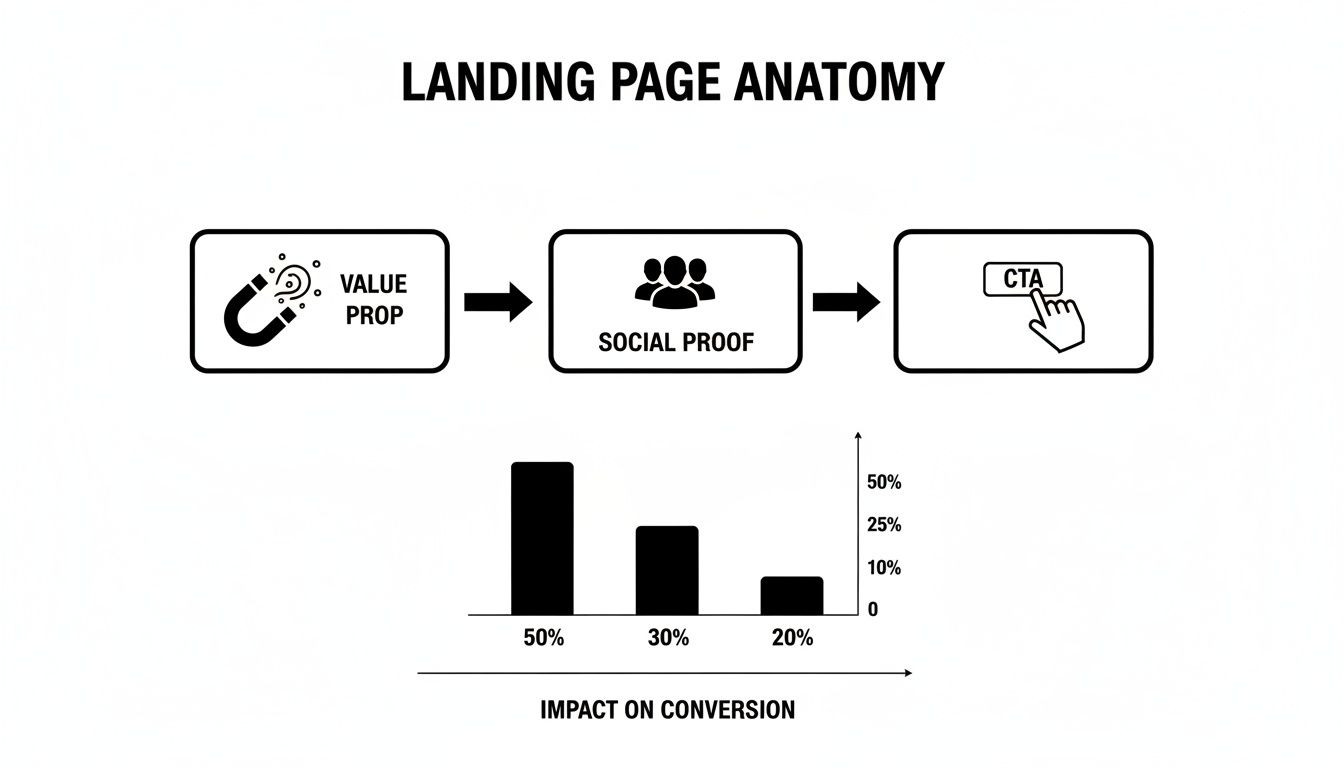
It highlights that a strong value proposition, credible social proof, and a clear call-to-action are the unshakeable foundation of any successful landing page, no matter how many versions you create.
By using professionally designed and optimized startup landing page templates, you completely remove the technical bottleneck. You empower your team to be fast, strategic, and responsive, turning what could be a resource drain into your most powerful growth lever.
How to Choose the Right Landing Page Template
So, you know what a great landing page does and why you need more than one. The next question is, how do you pick the right template?
Choosing a startup landing page template is about much more than just finding a design you like. You're picking the engine for your early-stage growth. The wrong choice can bleed time, money, and—most critically—conversions.
Think of it like buying a prefab home. Plenty of them look great from the curb. But you need to check the foundation, the quality of the materials, and whether the floor plan actually works for your life. A pretty exterior can easily hide a shoddy frame.
The same goes for templates. A beautiful design can mask sluggish code, a confusing user flow, and a complete lack of conversion strategy. To sidestep this trap, you need an evaluation framework. Forget getting dazzled by aesthetics and focus on what actually drives business results.
Look for a Conversion-First Design
The single most important job of your landing page is to get visitors to take action. A professional template is engineered with this goal baked into its very structure. It’s not a random collection of sections; it’s a deliberate user journey.
When you’re sizing up a template, ask yourself:
Is there a clear visual path? Your eye should naturally land on the headline first, then the benefits, and finally, the call-to-action (CTA).
Are the CTAs impossible to miss? Buttons need to pop off the page and use action-oriented words that tell the user exactly what to do next.
Does it have dedicated space for social proof? Look for well-designed spots for testimonials, client logos, and case studies. They shouldn't feel like a last-minute add-on.
A template built to convert guides users, anticipates their questions, and makes it incredibly easy for them to say "yes." This strategic thinking is what separates a professional tool from a pretty picture.
A great template doesn't just give you a place to put your content; it gives you a proven structure that makes your content more effective. It’s the difference between a random assortment of furniture and a professionally staged room designed to sell the house.
Prioritize Performance and Responsiveness
In a world of ever-shrinking attention spans, speed is a feature. A slow-loading page is the quickest way to lose a potential customer. Your template's underlying code is what dictates its performance.
And it goes without saying, your landing page absolutely must look and feel perfect on every device. With over 50% of web traffic now coming from mobile, a clunky or broken mobile view is a deal-breaker. It screams unprofessionalism and instantly erodes trust.
A premium template, especially one built on a modern platform like Framer, is engineered for speed and responsiveness from day one. This gives you a massive head start, as getting this right from scratch is a huge technical headache. You can learn more about how premium designs excel in our guide to performance-built SaaS landing page templates.
Ensure It Aligns with Your Brand and Goals
While aesthetics aren’t the only thing, brand alignment is still critical. Your landing page is often the very first time a customer will meet your brand. The template you choose has to feel like you.
Look for a template that’s highly customizable. Can you easily swap colors, typography, and images to fit your brand guidelines without breaking the entire layout? At FramerDevs, we provide templates with the source Figma files, so your team can nail the branding before a single line of code is touched.
Finally, think about the real cost. Building a page from scratch might feel "free" at first, but the hidden costs in developer time, design iterations, and lost opportunities are immense. A professional template is a smart investment that pays for itself through speed, quality, and most importantly, conversions.
To make the decision crystal clear, let's look at a direct comparison of the two paths.
DIY Landing Page vs. Professional FramerDevs Template
Here's how building a landing page from the ground up stacks up against using a professionally designed template, focusing on the outcomes that matter to a business.
Factor | Building From Scratch | Using a FramerDevs Template |
|---|---|---|
Time to Launch | Weeks or months | Hours or days |
Initial Cost | High (developer and designer salaries) | Low (one-time template purchase) |
Conversion Optimization | Guesswork and A/B testing from zero | Built-in from day one based on best practices |
Performance | Requires expert optimization (often skipped) | Optimized for 95+ Lighthouse scores out of the box |
Responsiveness | Needs extensive cross-device testing | Flawlessly responsive on all screen sizes |
Maintenance | Ongoing bug fixes and updates | Professionally maintained and updated |
The conclusion is pretty clear. While a DIY approach offers total control, it comes at a steep price in time and resources. For startups that need to move fast and validate ideas, a professional template from an expert like FramerDevs provides the perfect balance of speed, quality, and a conversion-focused foundation.
The Silent Conversion Killer: Slow Page Speed
Imagine a visitor, intrigued by your ad, lands on your page. They wait. One second… two seconds… three… and poof. They’re gone. This isn’t a wild guess; it’s the daily reality on the modern web. When it comes to startup landing page templates, the single most destructive—and most overlooked—factor is page speed. It’s the silent killer of conversions, quietly bleeding your revenue with every millisecond of delay.
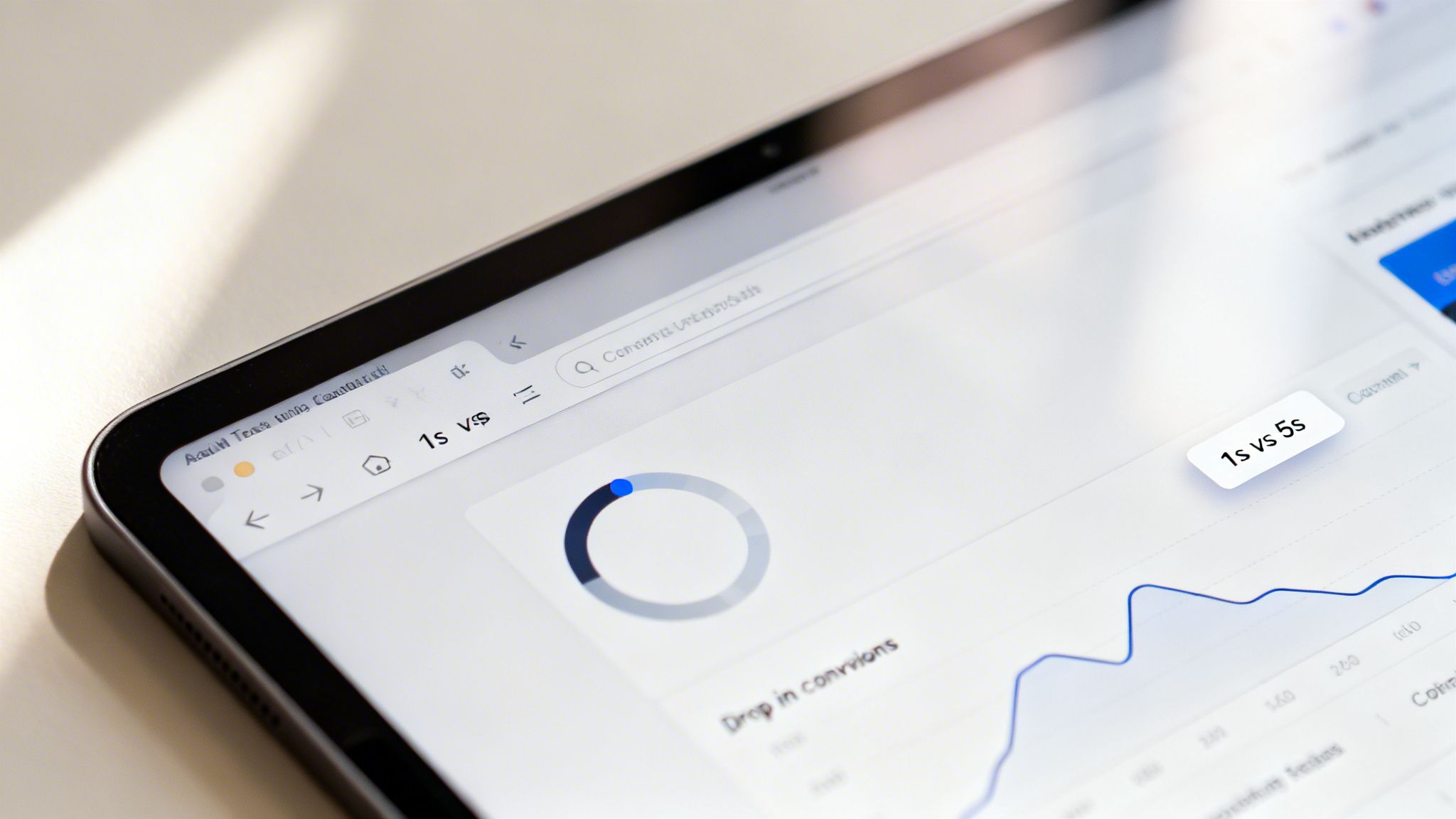
The data is just plain dramatic. Studies show that landing pages loading in one second convert at three times the rate of pages that take five seconds. Let that sink in. A few seconds of waiting can literally triple your sign-ups. For a startup fighting for every single customer, this is a number you absolutely cannot afford to ignore.
The Cost of Every Second
Every single second of load time has a real, measurable cost. To be precise, each second of delay shaves off roughly 7% of your potential conversions. This creates a critical performance line in the sand right at the 2-second mark. If your page takes any longer than that to become interactive, you are actively pushing potential customers away. This is even more true today, with user attention spans having shrunk from 2.5 minutes back in 2004 to just 47 seconds. You can find more data on how load times influence visitor behavior.
For a startup team building from the ground up, this is a huge technical roadblock. Optimizing for speed is a complex and time-consuming discipline that involves a whole lot more than just good design. We're talking about:
Image Compression: Manually resizing and compressing every single visual without making it look pixelated.
Code Minification: Stripping all the unnecessary characters from your HTML, CSS, and JavaScript files.
Server Configuration: Making sure your hosting is perfectly tuned for fast content delivery.
Lazy Loading: Deferring the loading of images and videos that aren't immediately visible on the screen.
This isn't a "set it and forget it" task. It’s a constant battle against bloat that most founders simply don't have the time for.
The Built-In Advantage of Optimized Templates
This is exactly where choosing the right foundation becomes a game-changer. A professional, performance-first template isn't just a design—it’s a pre-optimized speed machine. Instead of starting from zero and trying to bolt on performance later, you begin with a framework engineered for velocity from day one.
When you choose a performance-first template, you're not just buying a layout. You are buying back the conversions that would otherwise be lost to friction, frustration, and a spinning loading icon.
This is the entire philosophy behind the premium templates at FramerDevs. We build on Framer, a platform already known for its incredible performance, and we obsess over every tiny detail that makes a user experience fast. Our templates are built to hit 95+ Lighthouse scores right out of the box, which means you don't have to spend a single minute wrestling with technical debt.
By opting for an optimized startup landing page template, you’re making a smart business decision. You’re choosing to launch a page that respects your visitors' time, maximizes your marketing spend, and gives your brilliant idea the best possible shot at converting from the get-go. You get to bypass the entire optimization headache and go straight to publishing a page that is built to win.
Launch Your Landing Page in Hours, Not Weeks
The distance between a great idea and a live landing page that actually generates leads can feel impossibly wide. For too many startups, this is where momentum dies. The old-school path of custom development is a slow, expensive grind of mockups, coding sprints, and bug fixes that can take weeks or even months.
But what if you could skip all that? What if you could launch a polished, high-performance page in just a few hours?
That’s exactly what professional startup landing page templates let you do. Instead of staring at a blank screen, you start just a few steps away from the finish line. A premium template from an expert provider like FramerDevs turns a complicated technical project into a simple, visual process anyone can handle.
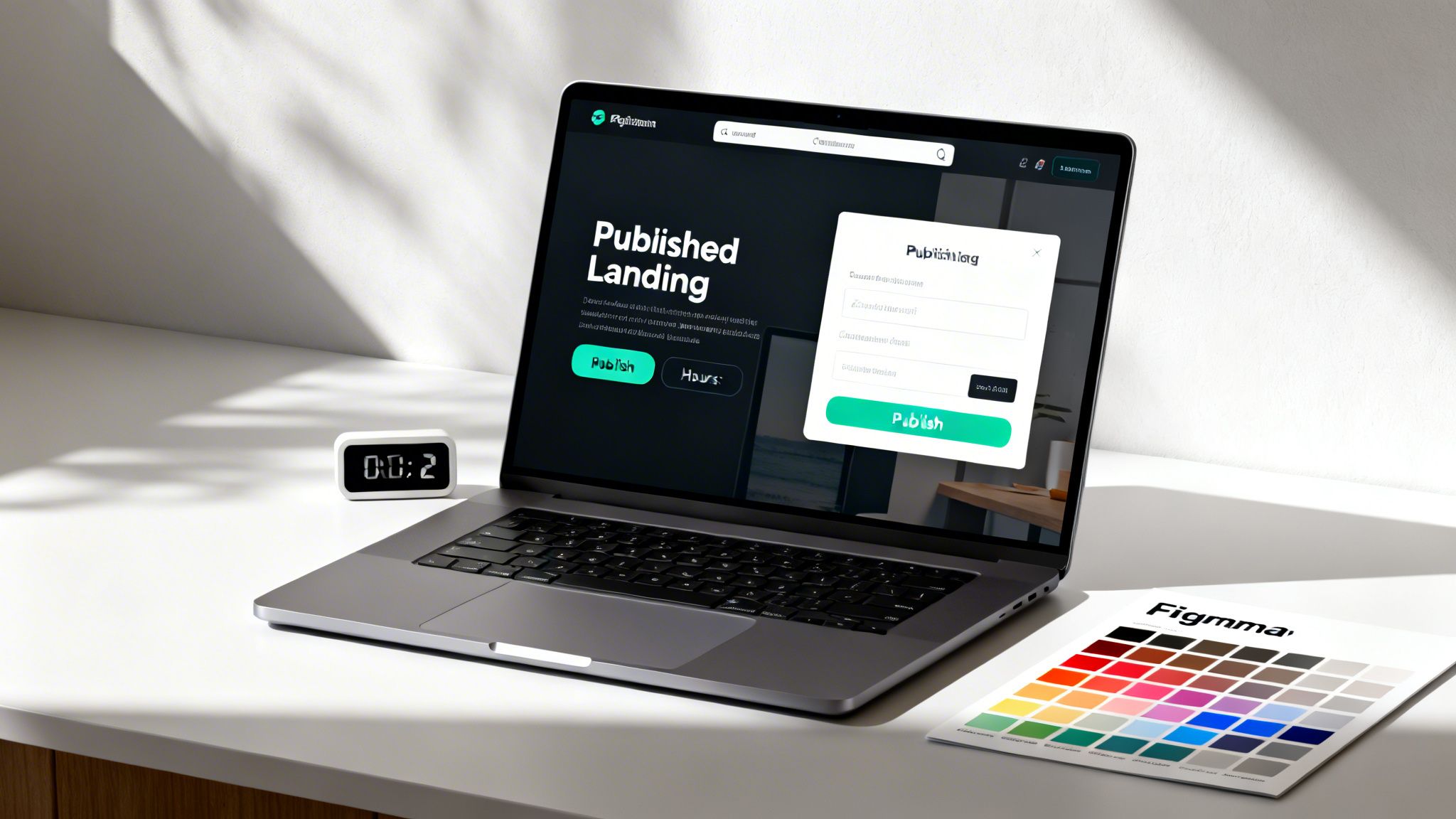
From Idea to Live in a Few Simple Steps
Think about it. You grab a professionally designed Framer template that already has a conversion-focused layout, responsive design, and solid performance baked in. Your job is no longer to build from scratch—it’s just to add your brand and hit publish.
The goal is simple: get a high-quality landing page live so you can start collecting leads today. It’s about trading technical headaches for business momentum.
The entire launch process gets broken down into a handful of manageable steps:
Pick Your Foundation: Start by choosing a template that matches your product and who you’re selling to.
Brand It in Figma: Use the included Figma source file to quickly apply your brand’s colors, fonts, and logos. This makes sure everything is consistent before you even open Framer.
Customize Visually: Open the template in Framer and start swapping out text and images. Just drag, drop, and type directly on the page. There is absolutely no code required.
Publish with One Click: Connect your custom domain, hit the publish button, and you're live. Your professional landing page is now out in the world, ready to do its job.
The Business Case for Moving Fast
This speed isn't just about convenience; it’s a huge strategic advantage for any startup. When you need to launch quickly, using a solid framework like the lunabloomai Starter App can cut down your development time and get you to market faster. By shrinking your launch timeline, you can start testing your ideas, gathering real feedback, and generating revenue right away.
Compare that to the traditional custom dev route, which is famously slow and expensive. The speed you gain from a template lets you be more agile. You can run multiple campaigns, A/B test your messaging, and pivot quickly without waiting on developers. You’re not just launching faster—you’re learning faster.
This whole approach is designed to be simple and direct. To make sure you don’t miss a thing, our complete website launch checklist is a great resource for a smooth publish. In the end, using a template means you can stop worrying about development and start focusing on what actually matters: growing your business.
Frequently Asked Questions
When you're diving into the world of startup landing page templates, a few common questions always pop up. Let's get them answered so you can pick the right one and launch your idea with total confidence.
What Is a Good Conversion Rate for a Landing Page?
Every founder wants to know this number. While it definitely shifts between industries, the latest data from late 2024 shows a median conversion rate of 6.6% across the board.
But you shouldn't aim for the median. Think of 6.6% as the absolute baseline. A truly solid landing page, especially one built from a conversion-focused template, should be doing much better. You can learn how top performers hit these numbers and redefine what success looks like.
Don't settle for average. The real goal is to beat the median. Top-quartile landing pages consistently hit conversion rates of 10% or more, which means turning way more of your ad spend into paying customers.
How Is a Landing Page Different from a Homepage?
It's simple: think of your homepage as the lobby of a building and a landing page as a private meeting room.
Your homepage is built for exploring. It has navigation, links to different sections, and gives a broad overview of your entire company. Its job is to direct all sorts of visitors to the right place.
A landing page, on the other hand, has exactly one job. It’s a standalone page built for a single marketing campaign with one clear call to action (CTA). It strips away all distractions—no nav bar, no extra links—to make sure visitors do the one thing you want them to, like signing up for a trial or downloading your guide.
Why Not Just Build a Landing Page from Scratch?
Building from scratch sounds like you're getting total control, but for most early-stage startups, it's a trap. It’s painfully slow, incredibly expensive, and demands a ton of expertise in design, development, and conversion optimization to get right. You’ll burn weeks on problems that experts have already solved.
Grabbing a premium FramerDevs template lets you skip that entire headache. You start with a foundation that’s already:
Conversion-Optimized: Built on proven layouts designed to guide users toward the CTA.
Performance-Tuned: Engineered from the ground up for 95+ Lighthouse scores to guarantee lightning-fast speed.
Fully Responsive: Designed to look and work perfectly on any device, from a tiny phone to a huge monitor.
Instead of building, you get to pour your limited time and money into what really matters: perfecting your message and actually growing your business. It's the fastest way to get from an idea to a professional, lead-generating machine.
Ready to launch your startup’s first impression in hours, not weeks? Explore the FramerDevs library of 100+ premium, conversion-focused templates and find the perfect design to fuel your growth.



